

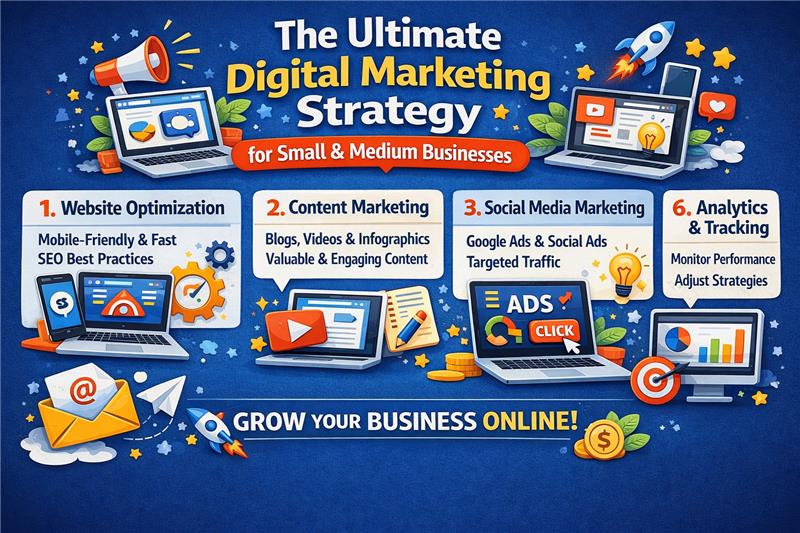
The Ultimate Digital Marketing Strategy For Small & Medium Businesses
In today’s competitive digital landscape, small and medium businesses (SMBs) can no longer rely solely on traditional marketing methods to grow. Customers are spending more time online than ever before, researching products, comparing brands, and interacting with businesses through digital channels. For SMBs, this shift presents a huge opportunity to compete with larger brands by using smart, targeted, and cost-effective digital marketing strategies.
A good digital marketing strategy allows you to reach the right people, gain their trust, capture their leads, and turn those leads into loyal customers. Unlike traditional advertising, digital marketing allows you to measure the results in real-time and make adjustments as you go. With the right combination of tools, channels, and strategies, small and medium-sized businesses can create their own growth engine.
This guide explores the ultimate digital marketing strategy that small and medium businesses can use to increase visibility, generate quality leads, and drive long-term success.
DEFINE CLEAR BUSINESS GOALS
Every successful marketing strategy starts with clear and measurable goals. Without defined objectives, businesses may invest time and resources in activities that do not deliver meaningful results.
Small and medium businesses should first identify what they want to achieve through digital marketing. Common goals include increasing website traffic, generating more leads, improving brand awareness, or boosting online sales. Setting specific targets such as increasing website visitors by 30% or generating 100 qualified leads per month helps guide marketing efforts.
Clear goals also make it easier to measure performance and determine which strategies are delivering the best return on investment.
UNDERSTAND YOUR TARGET AUDIENCE
Knowing your audience is one of the most important elements of a successful digital marketing strategy. Businesses that understand their customers can create more relevant and engaging marketing campaigns.
Start by defining your ideal customer profile. Consider factors such as age, location, profession, interests, challenges, and buying behavior. Understanding what problems your audience faces allows you to position your products or services as solutions.
Audience research can be done through website analytics, social media insights, customer surveys, and competitor analysis. The better you understand your audience, the more effectively you can communicate your value and attract the right customers.
BUILD A HIGH-PERFORMANCE WEBSITE
Your website acts as the foundation of your entire digital marketing strategy. It is often the first place potential customers visit to learn more about your business, services, and credibility.
A high-performing website should be fast, mobile-friendly, visually appealing, and easy to navigate. Visitors should quickly understand what your business offers and how it can help them. Clear messaging, engaging visuals, and simple navigation significantly improve user experience.
Equally important is having strong calls to action that encourage visitors to take the next step, whether it is contacting your business, requesting a quote, or subscribing to a newsletter. A well-optimized website converts traffic into leads and plays a key role in business growth.
INVEST IN SEARCH ENGINE OPTIMIZATION (SEO)
SEO is a fundamental element of long-term digital marketing for small and mid-size businesses. SEO helps increase your presence in search engine results when people are searching for products or services similar to yours.
Good SEO involves a combination of factors: creating content that works for both readers and search engines, improving the technical aspects of your website, and acquiring high-quality backlinks. By doing keyword research, you can understand the words people are searching for and create content that helps answer their questions.
For small businesses, local SEO is particularly significant. Optimizing your business listings, collecting patient (customer) reviews, and targeting specific location-based keywords can help bring in customers from the surrounding areas who are actively searching for the products or services you provide.
As with many things in life, patience is a virtue when it comes to SEO.
USE CONTENT MARKETING TO BUILD AUTHORITY
Content marketing plays a critical role in educating audiences and building trust with potential customers. Instead of focusing only on sales messages, businesses can create valuable content that answers questions, solves problems, and provides useful insights.
Blogs, guides, videos, infographics, and case studies are effective content formats that help attract and engage audiences. High-quality content also improves SEO performance by increasing website relevance and authority.
For SMBs, consistency is key. Publishing informative content regularly helps position your brand as a trusted expert in your industry. Over time, this builds credibility and encourages potential customers to choose your business over competitors.
LEVERAGE SOCIAL MEDIA MARKETING
Social media platforms provide powerful opportunities for small and medium businesses to connect directly with their audiences. Platforms such as Instagram, LinkedIn, Facebook, and TikTok allow businesses to share content, engage with followers, and promote their services.
A successful social media strategy focuses on providing value rather than simply promoting products. Educational posts, behind-the-scenes content, customer testimonials, and industry insights help build relationships with followers.
Engagement is equally important. Responding to comments, answering questions, and participating in conversations strengthens brand loyalty and trust. Over time, social media can become a strong channel for generating traffic and leads.
IMPLEMENT EMAIL MARKETING FOR CUSTOMER RETENTION
Email marketing remains one of the most effective digital marketing channels for nurturing leads and maintaining relationships with customers. Unlike social media platforms where algorithms control reach, email gives businesses direct access to their audience.
Small and medium-sized businesses can utilize email campaigns as a means of keeping their audience abreast of different news, offers, useful information, as well as personalized recommendations. Email campaigns, in particular, can be useful in guiding potential customers down the sales funnel.
For instance, you can use email campaigns to send welcome emails to new subscribers, education campaigns to prospects, as well as loyalty campaigns to existing customers. Email campaigns can be useful in increasing conversions, as well as fostering long-lasting relationships.
RUN TARGETED PAID ADVERTISING CAMPAIGNS
While organic strategies build long-term growth, paid advertising can deliver immediate results. Platforms like search engines and social media allow businesses to target highly specific audiences based on demographics, interests, and online behavior.
Paid campaigns can be used to promote products, generate leads, increase website traffic, or retarget visitors who previously interacted with your brand. Because digital ads provide detailed performance data, businesses can quickly adjust campaigns to improve results.
For SMBs with limited budgets, starting with small, well-targeted campaigns is often the most effective approach. Testing different messages, visuals, and audience segments helps identify the strategies that generate the best return.
USE DATA AND ANALYTICS TO OPTIMIZE PERFORMANCE
One of the greatest advantages of digital marketing is the ability to measure performance accurately. Tools such as website analytics platforms, social media insights, and advertising dashboards provide valuable data about audience behavior and campaign results.
Small and medium businesses should regularly monitor key performance indicators such as website traffic, conversion rates, email engagement, and advertising ROI. Analyzing this data helps identify what strategies are working and where improvements are needed.
Continuous optimization ensures marketing efforts remain efficient and aligned with business goals. Over time, data-driven decisions lead to stronger campaigns and better results.
FOCUS ON CUSTOMER EXPERIENCE AND TRUST
In the virtual world of the Internet, how you handle customers can be the difference between failure and success. Today’s customers expect rapid response times, open communication, and a consistent presence in all the ways they communicate. If you put customer happiness first, you’re likely to have better customer feedback, word-of-mouth advertising, and repeat sales. Good customer service, communication, and following through on commitments can establish a good brand reputation. Trust plays a large role for small to mid-size businesses that compete with large brands. If customers believe in you and your abilities, they’re more likely to choose you and speak about you.
CONCLUSION
Digital marketing offers powerful opportunities for small and medium businesses to grow in a competitive marketplace. By combining strategies such as SEO, content marketing, social media engagement, email campaigns, and targeted advertising, businesses can build a strong online presence and attract high-quality customers.
However, the key to success lies in creating a clear strategy, understanding your audience, and consistently delivering value through every digital channel. Businesses that embrace data-driven marketing and focus on long-term relationships will be better positioned to achieve sustainable growth.
With the right digital marketing strategy in place, small and medium businesses can compete effectively, expand their reach, and turn online opportunities into measurable success.